
By Lawrence Solomon, published by the Financial Post, October 28, 2026
Policy-makers say they want population growth but their intrusive policies rob potential parents of agency and the desire to have children.
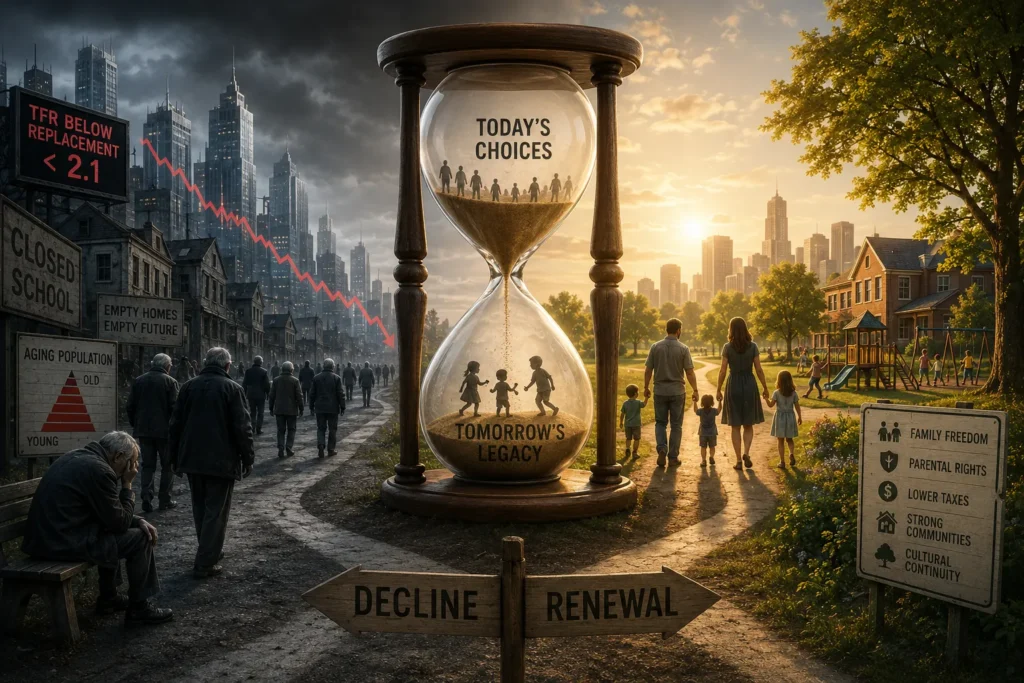
Existential threats to a nation and its citizens are hard to ignore — except when they arrive in the form of a low “total fertility rate” (TFR). This little-discussed metric signals a slow demographic death spanning generations as populations dwindle. Decline occurs imperceptibly, in small decrements, unannounced. Consequences seem far off: a low TFR creates no sense of urgency. We are the proverbial frog complacently basking in a slowly heating pool, unaware our doom awaits.
Population decline can reach a stage that is effectively irreversible. Demographers call it “negative population momentum.” It is driven by the pure dynamics of a shrinking cohort of women of childbearing age. Once the absolute number of women in peak reproductive years (roughly 20–35) contracts enough, even a return to the replacement TFR of 2.1 cannot generate sufficient births to offset deaths among larger elderly cohorts. When the median age of the female population approaches or exceeds the low-to-mid 40s, the share of women still of reproductive age becomes too small for natural recovery.
This process is well underway across the West and in affluent Asian countries. Because we are not replacing ourselves, each successive decade produces fewer children and the population ages. In 24 ultra-low-fertility countries whose populations have already peaked, United Nations assessments assign a near-zero probability to a sustained return to a healthy TFR of 2.1 within 30 years.
In the West, Canada and especially Quebec, which places high value on its distinct national identity, are particularly vulnerable. Canada’s TFR reached a historic low of 1.25 children per woman in 2024. Quebec’s rate stood at approximately 1.34 — the lowest ever recorded in the province and well below replacement. In Quebec in 2024 deaths already outnumbered births. Both Canada and Quebec have median ages in the low 40s (with Quebec’s higher), thus placing their female populations near the critical threshold.
Quebec’s situation is particularly stark under zero or tightly constrained net immigration. To protect its French language and cultural continuity, successive governments have deliberately limited both permanent and temporary immigration levels. With each successive reproductive-age cohort smaller than the last and deaths already exceeding births, the absolute number of potential mothers shrinks further. Once the reproductive-age base contracts past the tipping point, low fertility generates a self-reinforcing trajectory of long-term depopulation.
Governments have tried to stem the decline in Quebec and elsewhere with many different pro-natal policies — child-care support, mandated maternity leave, cash subsidies and so on. These attempts to reduce some of the burdens of parenthood implicitly assume cost is a major deterrent to having children. Yet families today have more disposable income and labour-saving appliances than a generation or two ago, when fertility rates were much higher. More government, it has been demonstrated repeatedly, is not the answer.
In fact, more government may be the problem. The greater the nanny state, the less agency parents retain and the more they are relegated to a form of surrogacy in which the state effectively co-parents their offspring. The state, not the parents, effectively decides: what vaccines and other medical procedures children will require; how they will be educated and for how long; what disciplinary methods are appropriate; and whether it’s in children’s best interest to change gender or have an abortion. These days the state even decides whether parents are entitled to know the health status of their children.
By relieving parents of primary responsibility for their children’s health, education, discipline, and major life choices, the state undermines their authority to guide their children, their purpose in deciding to have them, and their sense of obligation to maintain the legacy of their family, community, and country. Without primary control over the demanding, creative, terrifying, and decades-long commitment of raising children, parents are less and less likely to be rewarded with children who reflect their values, respect their efforts, continue their legacy and return their love.
The state not only moulds the child in its image, it also moulds the family through government programs that decide when a maternity leave begins and ends, who provides daycare and under what conditions, at what age children may work and what minimum wage they must be paid. In countless indirect ways, too, the state influences where and when people of all ages work, how they are housed, what information they consume and how they may communicate. Every such program, whether designed to aid fertility or not, robs people of agency and thus acts to dampen fertility.
Governments are charged, first and foremost, with securing the long-term welfare of their citizenry and country. Yet their horizons are notoriously short, limited to the next election. Getting governments to assume their primary responsibility — our long-term survival — by relinquishing control over us is a long shot. But it may be the only shot we have if we are to preserve our countries, cultures and freedoms.
Go to the publisher’s website here for the original version of this opinion piece.
For full commentary and analysis, subscribe to our newsletter (sign up below).
Lawrence Solomon, author of the forthcoming book, The Population Implosion, is executive director of Fertility Probe, a joint project of Canada’s Energy Probe Research Foundation and U.S.-based Probe International Foundation.